Maths Index
Curated tools and resources for secondary maths teachers that help build conceptual understanding.
Recently added
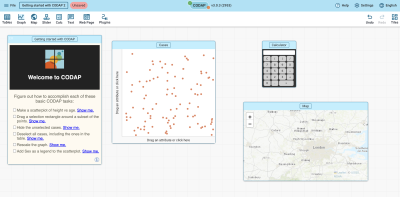
Common Online Data Analysis Platform (CODAP)
Explore large, real datasets with linked tables, graphs and maps. Built for GCSE and A-Level statist…
Open tool →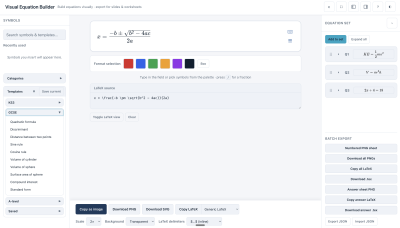
Equation Builder
Build maths equations visually and export clean PNG, SVG, or LaTeX for slides, worksheets, and the b…
Open tool →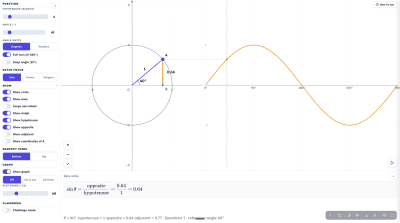
Unit Circle Explorer
Bridge GCSE triangle ratios and the A-Level unit circle, exact values and graphs.
Open tool →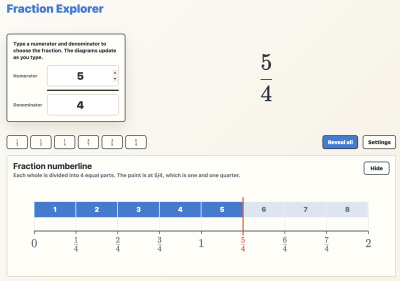
Fraction Explorer
Display a fraction across nine live representations — pie, money, decimal, percentage, equivalents, …
Open tool →Highlighted tools
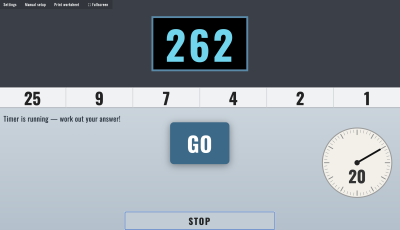
The Numbers Game
A fast-paced ''Countdown'' style arithmetic challenge. Pupils use six random numbers to reach a targ…
Open tool →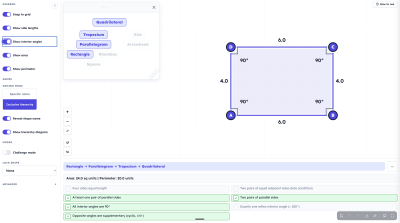
Quadrilateral Explorer
Explore the properties of quadrilaterals and the hierarchy of their types.
Open tool →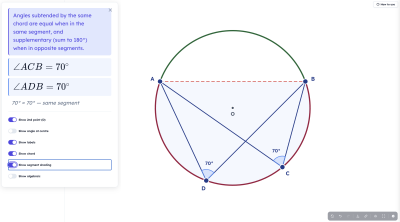
Circle Theorems Explorer
Explore all 8 circle theorems dynamically. Drag points, reveal construction lines, and switch betwee…
Open tool →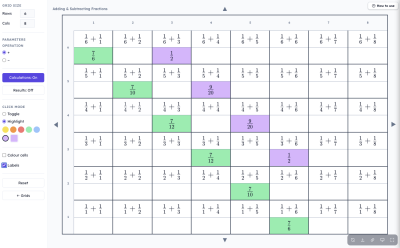
Structured Variation Grids
Two dimensional grids that help pupils to detect patterns, to imagine and express predictions and to…
Open tool →Be the first to hear about new tools → subscribe to monthly updates
MathsIndex is a curated directory of digital tools and resources designed specifically for secondary mathematics educators. The purpose is to support teachers as they help their pupils develop deep conceptual understanding. The tools gathered here include interactive manipulatives, dynamic explorers, and structured variation tasks.
Many wonderful maths tools have been created by large organisations and individual teachers. These often hide away on websites with many teachers oblivious to their existence. Others maybe discovered or used for a time, only to be forgotten again when a teacher loses their bookmark.
Although there are many people who are comfortable starting from scratch with digital manipulatives, dynamic geometry or graphing software, others are less confident or struggle to find the time to become confident enough to use them in the classroom. On this site we highlight tools that are as straightforward as possible to deploy in the classroom and to provide concise guidance to reduce the barriers to use. By organising them in one place, hopefully teachers will be able to discover and return to these tools, and through them their pupils will develop into better mathematicians.
← If you know of a tool that would benefit our aims, please suggest it using the link in the sidebar.
I hope that you find the things here useful, and if you do, please share with your colleagues so that they can benefit as well.

My small contributions to these tools are on my other site SenseMake.uk and are linked on this site in the relevant places.